Belbin Team Roles: What They Reveal About Why Teams Succeed or Fail

Most teams do not fail because they lack talented people.
They fail because they have the wrong mix of behaviours.
A team can be full of intelligent, experienced, hardworking people and still struggle to make decisions, execute plans, manage conflict, or deliver work to the required standard. This is the problem that Meredith Belbin’s Team Roles model was designed to explain.
Belbin Team Roles are often presented as a simple workplace exercise: identify whether someone is a Plant, Shaper, Co-ordinator, Teamworker, or one of the other roles, then use that knowledge to build a balanced team. But that summary is too shallow. The real value of Belbin’s work is not that it gives people labels. It is that it helps organisations understand why certain teams repeatedly underperform despite having capable individuals.
Belbin’s insight was simple but powerful: team performance depends on behavioural contribution, not just technical skill, intelligence, job title, or seniority.
That matters because most organisations still build teams around individual capability. They select the smartest people, the most experienced specialists, the strongest communicators, or the employees with the best track records. But they often fail to ask a more important question:
What behaviours does this team actually need in order to succeed?
A team that needs creative problem-solving but contains no strong idea generators will become incremental. A team that needs disciplined execution but lacks practical organisers will drift. A team that needs challenge but lacks critical evaluators will make confident mistakes. A team that needs cohesion but lacks relationship-builders will burn itself out through conflict.
Belbin Team Roles provide a practical way to diagnose these gaps.
What Are Belbin Team Roles?
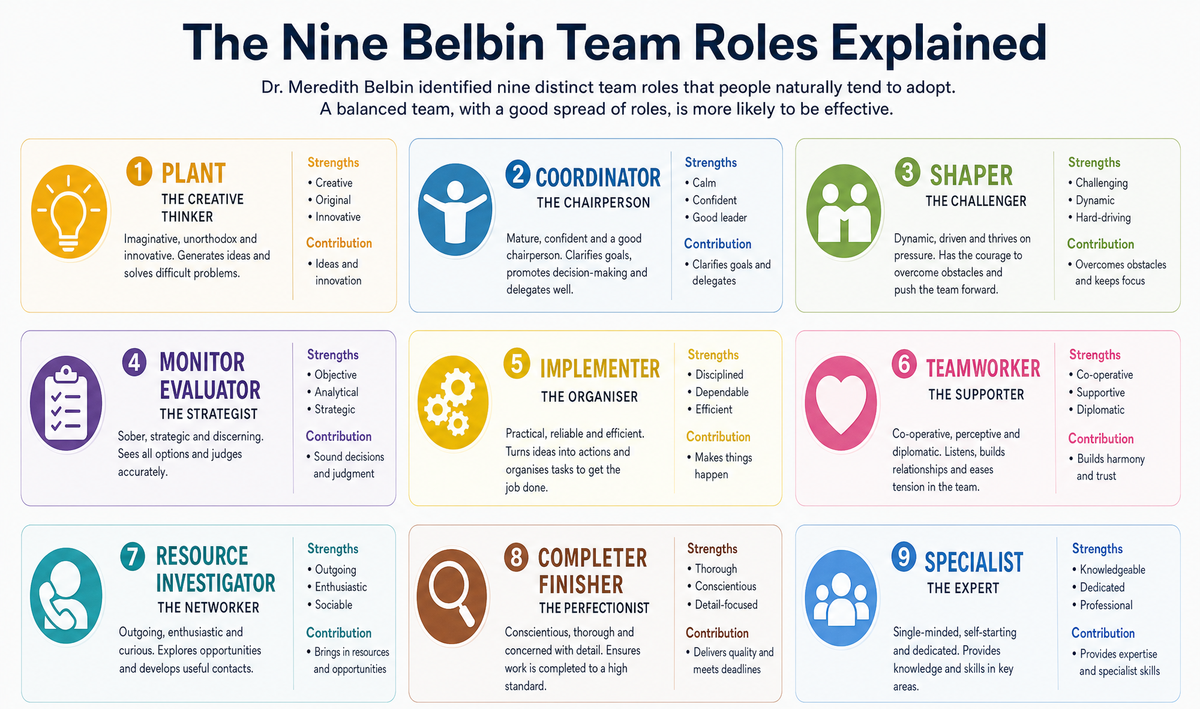
Belbin Team Roles are nine behavioural roles that describe how people tend to contribute in a team setting.
They are not personality types. This distinction matters. A personality type suggests something fixed about who a person is. A team role describes how a person behaves, contributes, and creates value in a group context.
Most people do not fit into only one Belbin role. They usually have two or three preferred roles, along with several roles they can perform adequately when needed. This means a team does not need nine people to cover the nine roles. A small team can still be behaviourally balanced if its members bring complementary strengths.
The nine Belbin Team Roles are usually grouped into three categories:
- Thought-oriented roles
- Action-oriented roles
- People-oriented roles
Each category answers a different team need. Thought-oriented roles help the team think. Action-oriented roles help the team execute. People-oriented roles help the team communicate, collaborate, and connect with the wider world.
A strong team does not need every role to be equally dominant at all times. But it does need enough role coverage for the work it is trying to do.
The Nine Belbin Team Roles Explained
1. Plant
The Plant is the team’s source of original ideas.
Plants are creative, imaginative, and often unconventional. They are good at seeing possibilities that others miss. When a team is stuck inside conventional thinking, the Plant can reframe the problem and suggest a new way forward.
This matters because teams without Plant energy often become too incremental. They improve what already exists, but they rarely question whether the existing approach is still the right one.
The weakness of the Plant is that they can be impractical. They may ignore details, lose interest in execution, or produce ideas that are not immediately usable. But this weakness is connected to the strength. The same mind that generates unusual ideas may not be the mind that turns those ideas into a workable delivery plan.
2. Monitor Evaluator
The Monitor Evaluator provides critical judgment.
This person is analytical, objective, and careful. They assess options, identify flaws, and help the team avoid weak decisions. They are especially valuable when a group is excited about an idea but has not yet tested the assumptions behind it.
This matters because teams often mistake confidence for quality. A persuasive idea can gain momentum before anyone has properly examined whether it is realistic, profitable, ethical, or strategically sound.
The weakness of the Monitor Evaluator is that they may appear negative or slow. Their caution can frustrate people who want quick action. But without this role, teams become vulnerable to overconfidence. They move fast, but in the wrong direction.
3. Specialist
The Specialist brings deep expertise.
Specialists contribute technical knowledge in a defined area. They are valuable when a team needs depth, precision, or subject-matter authority. In complex work, the Specialist prevents the team from relying on shallow assumptions.
This matters because many team decisions require more than general intelligence. They require domain knowledge. A group of smart generalists can still make poor decisions if they do not understand the technical realities of the problem.
The weakness of the Specialist is that they may focus narrowly on their own field. They can struggle to engage with broader team priorities if those priorities sit outside their area of expertise.
4. Shaper
The Shaper drives momentum.
Shapers are energetic, challenging, and goal-focused. They push the team to make progress, confront obstacles, and avoid complacency. When a team is drifting, the Shaper creates urgency.
This matters because teams can spend too long discussing possibilities without committing to action. The Shaper prevents endless debate from becoming a substitute for delivery.
The weakness of the Shaper is that they can be impatient, provocative, or confrontational. They may create friction, especially in teams that value harmony. But their challenge can also be necessary. Without Shaper energy, teams may avoid difficult decisions.
5. Implementer
The Implementer turns ideas into plans.
Implementers are practical, organised, and reliable. They take abstract goals and convert them into structured work. They build systems, assign tasks, and make sure the team’s strategy can actually be executed.
This matters because ideas have little value if they cannot be operationalised. Many teams are strong at discussion but weak at translation. They know what they want to achieve, but they do not build the process required to get there.
The weakness of the Implementer is that they may resist sudden changes. Because they value structure, they can become uncomfortable when the team keeps rethinking the plan. But that discipline is also what makes delivery possible.
6. Completer Finisher
The Completer Finisher protects quality.
Completer Finishers are detail-focused, conscientious, and careful. They check work, spot errors, and ensure that the final output meets the required standard. They are especially valuable near deadlines, launches, submissions, or delivery milestones.
This matters because many teams do most of the work but fail at the final stage. They produce something promising but unfinished, rushed, inconsistent, or full of avoidable mistakes.
The weakness of the Completer Finisher is that they can be anxious or perfectionistic. They may worry about details others see as minor. But those details often determine whether the team’s work is trusted.
7. Co-ordinator
The Co-ordinator brings people together around a shared objective.
Co-ordinators clarify goals, delegate effectively, and draw out contributions from others. They are not necessarily the loudest or most forceful person in the room. Their value lies in helping the team use its collective talent well.
This matters because teams often underuse their own resources. Strong voices dominate. Quiet expertise gets missed. Work is duplicated. Priorities become unclear. The Co-ordinator helps align effort.
The weakness of the Co-ordinator is that they may delegate too much or appear to contribute less directly. But in complex team environments, coordination itself is a major contribution.
8. Teamworker
The Teamworker maintains cohesion.
Teamworkers are diplomatic, supportive, and perceptive. They notice tension, repair relationships, and help people work through disagreement. They are especially important in teams with strong Shapers, Plants, or other dominant contributors.
This matters because team conflict is not automatically bad. In fact, some conflict is necessary. But unmanaged conflict damages trust, reduces psychological safety, and makes people less willing to contribute honestly.
The weakness of the Teamworker is that they may avoid confrontation. They can prioritise harmony over hard truth. But without Teamworker behaviour, teams can become politically unsafe and emotionally exhausting.
9. Resource Investigator
The Resource Investigator connects the team to the outside world.
Resource Investigators are curious, outgoing, and opportunity-focused. They explore external possibilities, build networks, gather information, and identify resources the team would not find internally.
This matters because teams can become trapped inside their own assumptions. They recycle the same ideas, use the same sources, and miss opportunities beyond their immediate environment.
The weakness of the Resource Investigator is that they may lose interest after the initial excitement. They are often better at opening doors than following through. But without this role, teams can become isolated and inward-looking.
Why Belbin Team Roles Matter
Belbin Team Roles matter because they shift the question from Who are our best people? to What does this team need to function well?
That is a much more useful question.
A team made up entirely of high-performing individuals can still be badly designed. It may have too many idea generators and not enough finishers. It may have too many relationship-builders and not enough challengers. It may have too many strategic thinkers and not enough people who can convert strategy into action.
This is why team composition is a resource allocation decision.
Every team needs a mix of behaviours. If one behaviour is missing, the team will usually compensate in unhealthy ways. For example, if there is no Monitor Evaluator, decisions may be made through enthusiasm, politics, or seniority. If there is no Implementer, plans may remain abstract. If there is no Teamworker, conflict may become personal. If there is no Plant, the team may keep optimising yesterday’s solution.
The long-term effect is predictable: the team’s weaknesses become patterned.
They do not make random mistakes. They make the same kind of mistake repeatedly.
The Apollo Syndrome: Why Smart Teams Fail
One of the most important ideas connected to Belbin’s research is the Apollo Syndrome.
Belbin observed that teams made up of highly intelligent individuals did not always perform well. In fact, some of these teams underperformed badly. They argued, analysed, challenged, and debated, but struggled to reach decisions or execute effectively.
This is the classic failure of an unbalanced team.
The issue was not a lack of intelligence. It was an excess of similar contribution. Too many people were trying to occupy the same behavioural space. The team had plenty of analysis, but not enough coordination. Plenty of critique, but not enough implementation. Plenty of intellectual horsepower, but not enough behavioural balance.
This still happens today.
It happens in technology companies that hire heavily for technical brilliance but underinvest in documentation, user experience, quality control, or customer understanding.
It happens in consulting teams that become trapped in analysis but struggle to produce a recommendation that clients can use.
It happens in leadership teams that contain several strategic thinkers but no one who creates operational discipline.
It happens in boards, committees, and project teams where everyone is capable, but the team still cannot move.
The lesson is not that intelligence is unimportant. Intelligence matters. Expertise matters. Experience matters. But they are not enough.
A team also needs behavioural variety.
Allowable Weaknesses: The Most Misunderstood Part of Belbin
One of the strongest parts of the Belbin model is the idea of allowable weaknesses.
Every role has a weakness that comes with its strength.
The Plant may be creative but impractical. The Monitor Evaluator may be objective but pessimistic. The Shaper may be driven but abrasive. The Completer Finisher may be quality-focused but anxious. The Resource Investigator may be enthusiastic but inconsistent.
These weaknesses are not random flaws. They are the cost of the contribution.
This matters because organisations often try to eliminate weakness without understanding what they are also eliminating. They want creative people who are never impractical, challengers who never create discomfort, perfectionists who never slow things down, and relationship-builders who never avoid conflict.
But real strengths usually have edges.
If you remove the edge completely, you may also remove the value.
We shouldn't focus on getting rid of every weakness. We should identify which weaknesses are acceptable because they come with a contribution the team genuinely needs. Positive trade off.
The problem comes when a team has the weakness without needing the strength, or when one role becomes so dominant that its weakness overwhelms the group.
Role Coverage Is More Important Than Role Count
A common misunderstanding of Belbin Team Roles is that every team needs nine people, with one person assigned to each role.
That is not the point.
The goal is not role count. The goal is role coverage.
A four-person team may cover all nine roles if each person brings two or three useful behavioural contributions. A nine-person team may still be unbalanced if several people cluster around the same roles while other roles are absent.
This has important implications for hiring, promotion, and project planning.
When a team is formed, leaders should not only ask:
- Who has the right experience?
They should also ask:
- What behaviours are already covered?
- What behaviours are missing?
- What phase of work are we entering?
- What type of failure are we most vulnerable to?
A team in the early stages of innovation may need strong Plant, Resource Investigator, and Monitor Evaluator input. It needs ideas, external insight, and critical judgment.
A team moving into delivery may need more Implementer, Co-ordinator, and Completer Finisher behaviour. It needs structure, accountability, and quality control.
A team in conflict may need Teamworker and Co-ordinator behaviour to rebuild trust and clarify responsibilities.
A team that is drifting may need Shaper energy to create momentum.
The right role mix depends on the work.
How Belbin Team Roles Change Across a Project
The value of each Belbin role changes depending on the stage of the team’s work.
Early stage: defining the problem
At the beginning of a project, the team needs to understand what is happening. This is where Plants, Resource Investigators, Specialists, and Monitor Evaluators are highly valuable.
The Plant generates possible approaches. The Resource Investigator brings in external examples, market signals, or stakeholder insight. The Specialist provides technical depth. The Monitor Evaluator tests whether the emerging options make sense.
If these roles are missing, the team may define the problem too narrowly. It may rush toward the most obvious solution without understanding the wider context.
Middle stage: planning the work
Once the team has chosen a direction, Co-ordinators and Implementers become more important.
The Co-ordinator clarifies who is doing what. The Implementer turns the chosen direction into a practical plan. The Shaper may also become useful here by keeping the group focused and preventing unnecessary delay.
If these roles are missing, the team may have a strong strategy but weak execution. Everyone broadly agrees on the goal, but the work does not move forward cleanly.
Final stage: delivery and quality control
Near completion, Completer Finishers become essential.
This is the point where details matter. The team needs someone to check the work, close gaps, identify errors, and make sure the final product is ready.
If this role is missing, the team may deliver something that is almost good enough. And 'almost good enough' is often where trust is lost.
At this stage, too much Plant behaviour can become disruptive. Reopening the big idea just before delivery may create confusion rather than value. This does not mean creativity is bad. It means creativity has to be timed properly.
Common Signs of an Unbalanced Team
Belbin Team Roles are useful because they help explain recurring team problems.
Here are some common patterns.
The team has ideas but does not execute
This usually points to weak Implementer or Completer Finisher coverage.
The team enjoys strategy, brainstorming, and discussion, but struggles to turn decisions into finished work. Meetings feel productive, but deadlines slip. The team may produce frameworks, notes, and concepts without delivering usable outputs.
The team executes but lacks originality
This may indicate weak Plant or Resource Investigator coverage.
The team is disciplined and reliable, but it rarely questions whether it is solving the right problem. It improves existing processes but misses bigger opportunities. Over time, it may become efficient but strategically stale.
The team moves quickly but makes avoidable mistakes
This often suggests weak Monitor Evaluator or Completer Finisher coverage.
The team is energetic and confident, but it does not test assumptions carefully enough. It ships work with errors, overlooks risks, or commits to decisions before the evidence supports them.
The team is harmonious but avoids hard decisions
This can happen when Teamworker and Co-ordinator behaviours dominate without enough Shaper or Monitor Evaluator input.
The team gets along, but difficult issues remain unresolved. People are polite in meetings but unclear in commitments. The desire to preserve harmony prevents the team from facing reality.
The team is full of debate but cannot decide
This is one version of the Apollo problem.
There may be too many Plants, Specialists, or Monitor Evaluators competing for intellectual authority. The team analyses every angle but struggles to commit. It values being right more than moving forward.
How to Use Belbin Team Roles in Practice
Belbin is most useful as a team diagnostic tool.
It should not be used to trap people inside fixed labels. Someone should not be permanently introduced as the Completer Finisher or the Plant as if that describes their whole professional identity.
Instead, use Belbin to ask better questions about team design.
1. Diagnose the team’s repeated failure pattern
Start by looking at the kind of mistakes the team keeps making.
Does the team fail through lack of ideas, lack of discipline, lack of challenge, lack of quality, lack of cohesion, or lack of external perspective?
The pattern tells you which role may be missing.
2. Map the roles the team already has
Identify which behaviours are strongly represented.
Do you have several people generating ideas? Several people challenging decisions? Several people building relationships? Several people organising delivery?
Over-representation matters as much as absence. Too much of one role can distort the whole team.
3. Identify the roles needed for the next phase
Do not assess the team against an abstract ideal. Assess it against the work ahead.
An innovation team, crisis team, delivery team, leadership team, and quality assurance team will not all need the same behavioural balance.
4. Adjust responsibilities before changing people
A role gap does not always require a new hire.
Sometimes the answer is to adjust responsibilities. A person with secondary Completer Finisher tendencies may need to be formally given quality control ownership. A natural Monitor Evaluator may need permission to challenge assumptions earlier. A Resource Investigator may need to be brought into the project before the team becomes too internally focused.
5. Hire for missing contribution
When the team genuinely lacks a behaviour, hiring should reflect that gap.
If a team already has five strategic thinkers, hiring another strategic thinker may feel comfortable but solve nothing. The better hire may be the person who brings structure, challenge, delivery discipline, or stakeholder connection.
The Limits of Belbin Team Roles
Belbin is useful, but it should not be treated as a perfect system.
It does not measure the quality of someone’s contribution. A person may fit the Monitor Evaluator role but still be poor at analysis. Someone may behave like a Co-ordinator but lack the judgment to delegate well. Role coverage is important, but competence still matters.
Belbin also should not be used as a rigid personality test. People adapt depending on context, seniority, pressure, team culture, and incentives. A person may behave differently in a small start-up team than they do in a large corporate committee.
The best use of Belbin is not to label individuals. It is to improve the design and functioning of the team.
Belbin Is About Balance, Not Boxes
Belbin Team Roles remain valuable because they explain something many organisations still get wrong.
Teams are not just collections of talented individuals. They are systems of contribution.
When the right behaviours are present at the right time, teams think better, decide better, execute better, and recover from conflict faster. When key behaviours are missing, teams develop predictable weaknesses. They may become clever but indecisive, fast but careless, harmonious but passive, disciplined but unimaginative, or creative but chaotic.
Team performance depends on behavioural balance.
A strong team needs people who can generate ideas, test assumptions, build plans, create urgency, maintain relationships, connect externally, provide expertise, and protect quality. Not every person needs to do all of those things. But the team needs them covered.