Kotter’s 8-Step Change Model: Organisational Transformation

In 2014, Microsoft wasn’t a failing company, but it was a stagnating one.
It had scale, distribution, and cash. What it didn’t have was momentum.
- Cloud? Amazon was miles ahead.
- Mobile? Google had already won.
- Culture? Internally described as political, siloed, and risk-averse.
Most incumbents in this position don’t collapse overnight.
They slowly become irrelevant.
And yet, within a decade, Microsoft became one of the most valuable companies in history.
This wasn’t driven by a single product breakthrough.
It was driven by something much rarer:
A successful, sustained organisational transformation.
And if you look closely, that transformation maps almost perfectly to Kotter’s 8-Step Change Model.
Which creates a paradox:
If Kotter’s model is so widely known — why do ~70% of transformations still fail?
The Real Problem: Misunderstanding What Kotter’s Model Is
Most leaders think Kotter’s model is:
- A process
- A checklist
- A sequence of steps
It isn’t.
It’s a model of how organisational behaviour changes under pressure.
This distinction matters because:
- Checklists optimise for completion
- Behavioural systems optimise for outcomes
And transformation is not about completing steps.
It’s about shifting how thousands of decisions get made every day.
That’s why simply doing the steps produces what we might call:
Change theatre: visible activity with no underlying behavioural shift
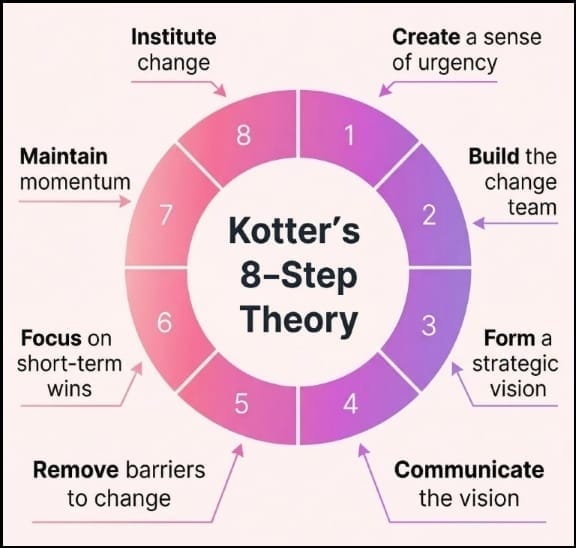
Step 1: Create Urgency
Most organisations treat urgency as a communication problem.
They present:
- market data
- competitor threats
- declining performance
And assume awareness will trigger action.
It doesn’t.
Because urgency is not cognitive, it’s behavioural.
What Actually Creates Urgency
Urgency emerges when inaction becomes personally costly.
That typically requires:
- Incentive changes
- Status loss
- Resource reallocation
- Time compression
Microsoft’s key move was eliminating stack ranking.
That instantly changed:
- how people collaborated
- how performance was evaluated
- how success was defined
Urgency is best understood as a shift in local optimisation functions.
People don’t change because the company needs to change.
They change because their personal payoff structure changes.
Operator Diagnostic
Ask:
- What behaviour was rational last quarter but is now penalised?
- What behaviour is newly rewarded?
If you can’t answer clearly, urgency doesn’t exist.
Step 2: Build a Guiding Coalition
Most companies confuse inclusion with alignment.
They build large committees to represent stakeholders.
This creates:
- diluted accountability
- slow decisions
- political compromise
What a Real Coalition Looks Like
A true guiding coalition is:
- small (10–20 people)
- cross-functional
- disproportionately influential
It includes people who control:
- budgets
- hiring
- promotions
- strategic decisions
Microsoft’s Approach
Rather than appointing a coalition, Nadella restructured the organisation so that:
- collaboration was necessary
- silos were costly
- influence shifted toward builders, not gatekeepers
Coalitions are revealed by power structures.
If your org chart contradicts your transformation, the org chart wins.
Operator Diagnostic
Map:
- Who actually decides what gets funded?
- Who can block decisions?
- Who defines success metrics?
If these people aren’t aligned, your transformation is structurally impossible.
Step 3: Strategic Vision
Most visions fail because they are:
- additive (do more things)
- vague (open to interpretation)
- non-binding (no trade-offs)
What a Real Vision Does
A real strategic vision:
- constrains decision-making
- eliminates options
- reallocates resources
“Cloud-first, mobile-first” worked because it forced:
- deprioritisation of Windows dominance
- investment in Azure
- support for competitor ecosystems
A vision’s strength is proportional to:
The number of good ideas it kills
Weak visions expand possibility.
Strong visions reduce it.
Operator Diagnostic
List your last 5 major decisions.
Ask:
- Could we have made these decisions before the vision?
If yes, the vision is not operational.
Step 4: Enlist a Volunteer Army
Change spreads through networks, not announcements.
Most companies rely on:
- emails
- presentations
- internal campaigns
But behaviour spreads via:
- peer imitation
- leadership modelling
- local norms
Microsoft’s Key Lever
Nadella modelled:
- curiosity
- vulnerability
- learning
At the top of the organisation.
This matters because:
- senior behaviour defines acceptable behaviour
- middle managers replicate what gets rewarded
Change adoption follows a diffusion curve:
- innovators
- early adopters
- majority
- laggards
Your goal is not 100% alignment immediately.
It’s reaching critical mass (~25–30%) where behaviour becomes self-reinforcing.
Operator Diagnostic
Find your early adopters:
- Who is already behaving differently?
- Are they visible, rewarded, and promoted?
If not, diffusion will stall.
Step 5: Remove Barriers
This is where transformations usually fail.
Because real barriers are:
- political
- structural
- expensive
Types of High-Impact Barriers
- Incentive misalignment
- Legacy org structures
- Technical constraints
- Key individuals resisting change
Most companies address only process friction.
Microsoft’s Critical Move
Eliminating stack ranking removed:
- internal competition
- knowledge hoarding
- zero-sum thinking
This unlocked collaboration at scale.
Barriers are equilibrium stabilisers.
They exist because they previously worked.
Removing them creates instability — which is necessary for change.
Operator Diagnostic
Ask:
- What behaviour do we say we want but punish in practice?
That gap is your real barrier.
Step 6: Generate Short-Term Wins
Short-term wins are often misunderstood as:
- quick results
But their real function is:
- credibility signalling
What Makes a Strong Win
A strong win is:
- visible
- strategically aligned
- repeatable
Microsoft’s Office on iPad launch:
- generated revenue
- validated the new strategy
- signalled seriousness internally
Wins serve as belief-updating mechanisms.
People don’t commit to strategy — they commit to evidence.
Operator Diagnostic
For each win, ask:
- Does this prove the new strategy works?
- Or just that we can execute the old one?
Step 7: Sustain Acceleration
Organisations naturally revert to equilibrium.
This is inertia.
Why Transformations Stall
- fatigue
- leadership distraction
- early success complacency
- competing priorities
What Sustained Acceleration Requires
- continued investment
- visible leadership focus
- expanding scope of change
- reinforcement loops
Microsoft sustained momentum through:
- acquisitions (LinkedIn, AI investments)
- platform expansion (Azure)
- cultural reinforcement systems
Transformation is compounding.
Each successful change:
- increases capability
- reduces resistance
- accelerates future change
Operator Diagnostic
Ask:
- Is change getting easier or harder over time?
If harder, momentum is failing.
Step 8: Anchor Change in Culture
Culture is often misunderstood as:
- values
- messaging
- identity
In reality:
Culture = incentives + norms + selection effects
What Actually Changes Culture
- who gets promoted
- who gets fired
- how performance is measured
Microsoft embedded change into:
- performance reviews
- collaboration metrics
- leadership expectations
Culture changes through selection pressure:
- people aligned with new behaviours stay
- others leave
Over time, this shifts the baseline.
Operator Diagnostic
Look at:
- last 10 promotions
- last 10 exits
Do they reinforce the future or the past?
Kotter vs. Continuous Change: When the Model Breaks
Kotter assumes:
change is episodic
But some companies operate in continuous change mode.
Netflix is the clearest example.
Instead of structured transformation, it built:
- high talent density
- low process
- rapid decision-making
Trade-Off
| Model | Strength | Risk |
|---|---|---|
| Kotter | Structured, scalable | Slower |
| Continuous (Netflix) | Fast, adaptive | High internal pressure |
Strategic Insight
Choose based on:
- industry volatility
- regulatory constraints
- organisational maturity
Why 70% of Change Initiatives Fail (Synthesised)
Most failures trace back to four root causes:
- No real urgency (only communication)
- No power alignment (only committees)
- No structural change (only messaging)
- Premature completion (change stopped too early)
These map directly to misuse of Kotter’s model.
Kotter Is a Model of Energy, Not Process
Kotter’s framework works when understood as:
- urgency → energy
- barriers → friction
- wins → momentum
- culture → equilibrium
Transformation succeeds when:
- energy > resistance over time
Most organisations never sustain that imbalance long enough.
Final Points
If you’re applying Kotter’s 8-Step Change Model:
Start asking:
- Where is resistance still winning?
- What behaviours haven’t changed?
- What incentives still reinforce the old system?
Because transformation is not complete when the plan ends.
It’s complete when:
the old way becomes impossible to return to