The Wall Street Crash & The Great Depression (1929–1933): Investors Report

Executive Summary
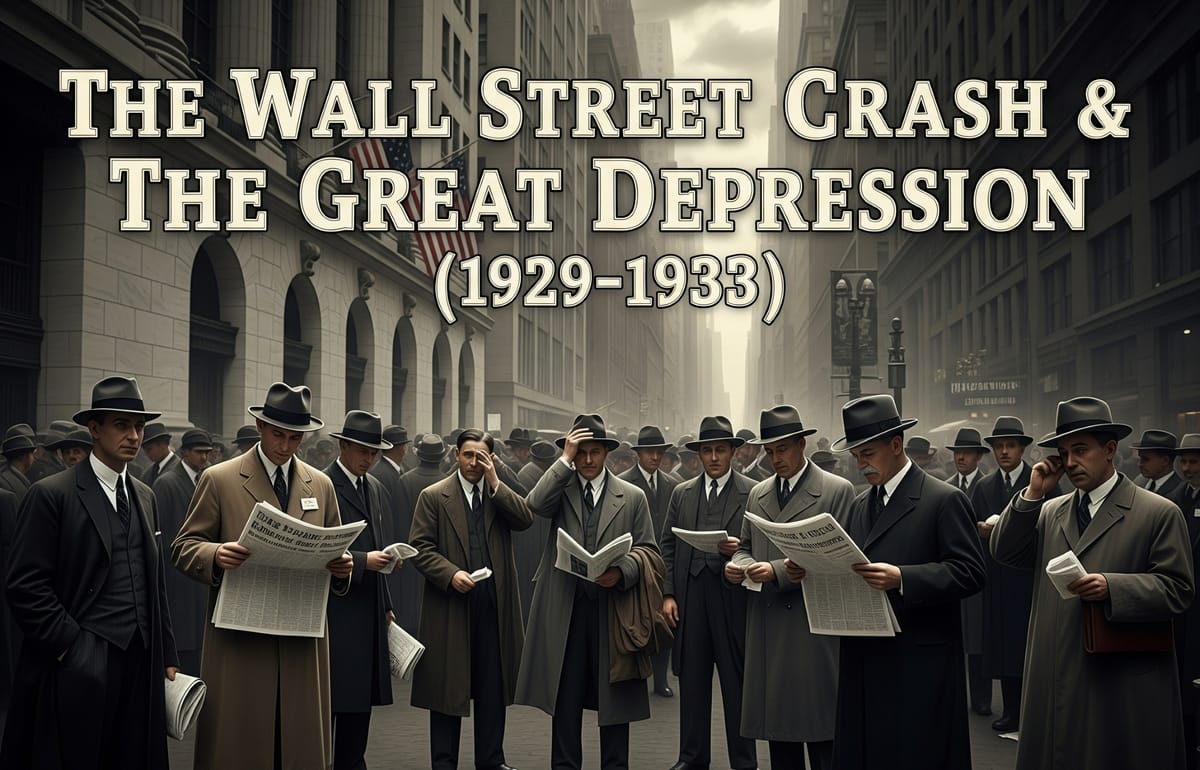
Between 3 September 1929 and 8 July 1932, the Dow Jones Industrial Average fell 89.2% — from its intraday peak of 381.17 to a trough of 41.22 — destroying approximately $30 billion in market capitalisation (equivalent to roughly $500 billion in today's dollars) and triggering a global depression that lasted a decade.
The single most important lesson is deceptively simple: leverage kills.
When an entire financial system — from retail speculators borrowing on 10% margin to investment trusts layered three and four deep in pyramidal structures — is built on borrowed money, even a modest decline in asset prices triggers a self-reinforcing liquidation spiral that no individual actor, no consortium of bankers, and no central bank intervention can arrest.
The Crash of 1929 did not cause the Great Depression on its own; a cascade of catastrophic policy errors by the Federal Reserve, the Hoover administration, and the international community transformed a severe market correction into civilisational catastrophe. But the market’s vertical collapse was made inevitable by the architecture of leverage that preceded it, and every subsequent crisis — from 2008 to the crypto implosions of 2022 — has replayed this same fundamental mechanism.
The Conditions That Made It Possible
The Roaring Twenties
The decade following the sharp but brief recession of 1920–21 produced one of the most extraordinary expansions in American economic history. Real GDP grew at an annualised rate of approximately 4.2% between 1922 and 1929. Unemployment hovered between 1.8% and 3.3% for most of the decade. Consumer prices were essentially flat, rising barely 1% across the entire period, which gave the Federal Reserve — barely fifteen years old and still uncertain of its own powers — no inflationary signal to provoke tightening. Industrial production doubled. Automobile registrations tripled from 10.5 million in 1921 to over 26 million by 1929. Electricity reached two-thirds of American homes. The assembly line, mass production, and scientific management were transforming the productive capacity of the economy in ways that felt, to contemporary observers, genuinely permanent.
Corporate earnings were rising smartly. US Steel’s net income doubled between 1925 and 1929. General Motors reported record profits year after year. Radio Corporation of America (RCA) saw revenues grow tenfold between 1925 and 1929 as radio ownership exploded from 2 million to 10 million households. The fundamental backdrop was authentically strong, and this is precisely what made the mania so dangerous — the bull case was rooted in real economic performance, making it psychologically impossible for participants to distinguish between rational appreciation and speculative excess.
Credit Conditions and Leverage
The mechanism that transformed a legitimate bull market into a catastrophic bubble was margin lending. Throughout the 1920s, investors could purchase stocks on margin of as little as 10% — meaning a speculator with $1,000 could control $10,000 in equities. Brokers’ loans to customers, the standard measure of margin credit, rose from $1.5 billion in early 1926 to $2.6 billion by the start of 1928, and then nearly tripled to $8.5 billion by September 1929. At the peak, brokers’ loans represented roughly 10% of the entire capitalisation of the New York Stock Exchange.
The source of this credit was itself extraordinary. Banks were not the only lenders. By 1929, corporations flush with cash were lending directly into the call money market at rates of 8–12%, far exceeding the returns available on their own businesses. Standard Oil of New Jersey, Bethlehem Steel, and Chrysler were all active lenders. Foreign banks funnelled capital into New York call loans. The entire system had become a giant carry trade: borrow short to lend into the speculative market, relying on continuously rising stock prices to keep the collateral adequate.
Compounding the direct margin lending was the investment trust mania. Investment trusts — the closed-end fund predecessors of modern mutual funds — proliferated wildly in 1928 and 1929. In 1927, 140 new trusts were formed. In 1929 alone, that number exceeded 500. Many employed aggressive leverage, borrowing to amplify returns. Worse, trusts owned shares of other trusts, creating pyramidal structures where a 10% decline in the underlying equities could wipe out 50–70% of the leveraged trust’s net asset value. Goldman Sachs Trading Corporation was the most notorious example: it spawned the Shenandoah Corporation, which in turn created the Blue Ridge Corporation, each layer adding leverage on top of the last. At the peak, a $1 investment at the bottom of the pyramid might control $10 or more of underlying equities.
Prevailing Psychology: The New Era Delusion
What distinguished the late 1920s from a garden-variety bull market was the widespread conviction that the business cycle itself had been conquered. The phrase “New Era” entered common usage, and its logic was seductive: mass production reduced costs; scientific management eliminated waste; the Federal Reserve could smooth recessions; America’s productive superiority was unassailable. The idea that stocks might be permanently valued at higher multiples was mainstream.
“Stock prices have reached what looks like a permanently high plateau.” — Professor Irving Fisher, Yale University, 16 October 1929
Fisher was arguably the most distinguished American economist of his generation, and his statement was simply the clearest articulation of what most market participants already believed. The financial press reinforced the consensus relentlessly. The Wall Street Journal, Barron’s, and the financial pages of the New York Times ran story after story emphasising corporate earnings growth, technological progress, and the wisdom of stock ownership for the ordinary citizen. Dissent was treated as evidence of intellectual inadequacy.
The Regulatory Vacuum
The Securities and Exchange Commission did not yet exist. There was no federal regulation of stock exchanges, no requirement for companies to file audited financial statements, no prohibition on insider trading, and no oversight of margin lending beyond the loosely coordinated actions of the Federal Reserve and the New York Stock Exchange. Manipulation was standard practice. Bear raids, wash sales, and pool operations were conducted openly by the leading operators of the day. Broker-dealers had no capital requirements. Investment trusts published whatever information they chose. The market was, in the most literal sense, a casino with no gaming commission.
Political Context
Calvin Coolidge’s presidency (1923–1929) was defined by a philosophy of minimal government intervention in markets. His Treasury Secretary, Andrew Mellon, was one of the wealthiest men in America and a devoted advocate of low taxes and limited regulation. The political class had no appetite for restraining a boom that was generating enormous wealth and tax revenues. When Herbert Hoover assumed office in March 1929, he privately harboured concerns about speculation but publicly did nothing to dampen it, later writing in his memoirs that he had warned Coolidge repeatedly but was ignored.
The Key Players
The Architects
Charles E. Mitchell, Chairman of National City Bank (predecessor to Citigroup), was the single most influential banker of the boom. Mitchell aggressively promoted stock speculation to retail customers through National City’s securities affiliate, pioneering the mass marketing of equities and bonds to middle-class Americans. In March 1929, when the Federal Reserve signalled that it might raise the discount rate to cool speculation, Mitchell publicly defied the central bank, announcing that National City would lend $25 million into the call money market to prevent a credit squeeze. The market rallied instantly, and the Fed backed down. Mitchell had demonstrated, in the starkest possible terms, that private capital could override public authority. He was eventually indicted for tax evasion in 1933, though acquitted at trial. His reputation never recovered.
Albert Wiggin, Chairman of Chase National Bank, took the architecture of moral hazard to its logical extreme. While publicly expressing confidence in the market and serving on the NYSE’s governing committee, Wiggin was secretly short-selling Chase’s own stock through personal holding companies in the autumn of 1929. He profited approximately $4 million from the crash. When the Pecora Commission exposed his activities in 1933, the revelations became a defining emblem of Wall Street’s corruption and directly fuelled the passage of the Securities Exchange Act of 1934.
Goldman Sachs Trading Corporation, under the direction of Waddill Catchings, embodied the investment trust mania at its most reckless. Floated in December 1928 at $104 per share, it peaked at $326 in early 1929 before its layered leverage turned against it. By 1932, shares traded at $1.75. The $500 million in nominal value created by Goldman’s trust structures had been almost entirely destroyed, and the reputational damage haunted Goldman Sachs for a generation — the firm did not dare underwrite another public offering for years.
The Cassandras
Roger Babson, the eccentric statistician and forecaster, delivered a speech on 5 September 1929 at the Annual National Business Conference in Wellesley, Massachusetts, in which he declared that a crash was coming and that it could be terrific. The Dow fell nearly 3% that afternoon in what the press immediately labelled the Babson Break. But Babson had been warning about an imminent crash since at least 1926, and his repeated false alarms had cost him credibility. The market recovered within days. The financial establishment dismissed him as a perennial bear who had finally been right by accident.
Paul Warburg, the German-born banker who had helped design the Federal Reserve System itself, issued a prescient public warning in March 1929. He cautioned that unchecked speculation would produce a collapse that could engulf the entire economy. He was savaged in the financial press. Barron’s accused him of sandbagging American prosperity. He largely withdrew from public commentary afterward, having learned the lesson that markets punish early accuracy as severely as they punish error.
Joseph P. Kennedy reportedly exited the market in early 1929 after a shoeshine boy offered him stock tips, concluding that when shoeshine boys were giving market advice, the market had no further upside. The story may be apocryphal, but Kennedy did reduce his equity exposure substantially in the first half of 1929 and shifted into short positions and cash. He emerged from the crash wealthier than he entered it, and Roosevelt later appointed him the first Chairman of the SEC — on the theory, as FDR supposedly remarked, that it takes a thief to catch a thief.
The Regulators
Benjamin Strong, Governor of the Federal Reserve Bank of New York and by far the most capable central banker in America, died on 16 October 1928 — exactly one year before the crash reached its most acute phase. Strong had managed monetary policy through personal relationships and pragmatic interventionism. His death left a vacuum filled by cautious, conflicting voices on the Federal Reserve Board in Washington, who could not agree on whether to address speculation through direct action (restricting member bank lending to brokers) or indirect action (raising the discount rate). The result was paralysis at the worst possible moment. Friedman and Schwartz argued persuasively in their Monetary History that Strong’s death was one of the most consequential individual events in American economic history.
Herbert Hoover, 31st President of the United States, has been unfairly caricatured as a do-nothing president. In reality, Hoover was an activist who convened conferences, pressured businesses to maintain wages, launched public works projects, and created the Reconstruction Finance Corporation. But he was ideologically committed to balanced budgets and gold standard orthodoxy, and his activism was consistently too little, too late, and misdirected. His catastrophic decision to sign the Smoot-Hawley Tariff Act in June 1930, despite the opposition of over 1,000 economists who signed a public petition against it, accelerated the global trade collapse that turned an American recession into a worldwide depression.
Andrew Mellon, Treasury Secretary under Coolidge and initially under Hoover, advocated the liquidationist position with chilling clarity. His advice to Hoover, later recorded in the president’s memoirs, was to “liquidate labour, liquidate stocks, liquidate the farmers, liquidate real estate” — let the purge run its course and the economy would emerge stronger. This reflected a genuine economic philosophy, shared by many orthodox economists of the era, that downturns were necessary purgatives. But it was spectacularly wrong as policy advice during a debt-deflation spiral.
The Casualties
Irving Fisher lost virtually his entire fortune, estimated at between $8 million and $10 million (roughly $140–175 million in today’s money). Having publicly proclaimed the permanent plateau, he continued buying stocks on margin even as the market collapsed, and was ultimately bailed out by Yale University, which purchased his home and rented it back to him to save the distinguished professor from eviction. He spent the rest of his career trying to rehabilitate his reputation, and his work on debt-deflation — written from the ashes of personal ruin — remains one of the most important contributions to understanding financial crises.
The broader American public suffered on a scale difficult to comprehend. By 1933, real GDP had fallen 30% from its 1929 peak. Unemployment reached approximately 25%, with some industrial cities exceeding 50%. Over 9,000 banks failed between 1930 and 1933, wiping out the savings of millions of depositors in an era before federal deposit insurance. Farm income collapsed by 60%. Homelessness became endemic. Breadlines stretched around city blocks. The suicide rate rose 22.8% between 1929 and 1932, from 13.9 to 17.4 per 100,000. The human devastation was immense, long-lasting, and fundamentally altered the relationship between American citizens and their government.
The Trigger & The Cascade
The Peak and the Early Cracks: September 1929
The Dow Jones Industrial Average reached its all-time closing high of 381.17 on 3 September 1929. That day, a warm Tuesday after the Labour Day weekend, the market’s mood was still buoyant. The New York Times financial section led with optimistic commentary on autumn earnings prospects. Trading volume was moderate. There was no single event that marked the top — the market simply stopped going up.
Through September, the market drifted lower without urgency. The Babson Break on 5 September was absorbed. But beneath the surface, conditions were deteriorating. Industrial production had peaked in June. Steel output was declining. Automobile sales were softening. Freight car loadings — a closely watched real-time indicator — had been falling since midsummer. The economy was already entering recession before the stock market crashed, a fact obscured at the time by the lag in economic statistics.
The London Trigger: The Hatry Affair
On 20 September 1929, the collapse of Clarence Hatry’s financial empire in London sent a tremor through global markets. Hatry, a British financier, was arrested for fraud after his attempt to acquire United Steel Companies collapsed and revealed that he had financed the bid with forged securities. The Bank of England raised its discount rate from 5.5% to 6.5% on 26 September in response, pulling gold and capital away from New York. The Hatry affair was not a direct cause of the Wall Street crash, but it tightened global liquidity at a fragile moment and demonstrated that fraudulent leveraged structures could unravel with stunning speed.
Black Thursday: 24 October 1929
The opening bell on Thursday, 24 October sounded over a floor already thick with sell orders accumulated overnight. Within the first thirty minutes, prices were falling so rapidly that the ticker tape — the era’s only mechanism for transmitting prices to the outside world — fell behind. By 11:00 am, the tape was running over an hour late, meaning that investors across the country were making decisions based on prices that no longer existed. Panic fed on ignorance. Crowds gathered outside the Stock Exchange on Broad Street, and police were deployed to maintain order.
At noon, a consortium of the most powerful bankers in America met at the offices of J.P. Morgan & Co., directly across the street from the Exchange. Thomas Lamont, the acting head of the Morgan bank, chaired the meeting. Charles Mitchell of National City Bank, Albert Wiggin of Chase National, Seward Prosser of Bankers Trust, and George Baker Jr. of First National each committed approximately $40 million to a stabilisation pool, totalling roughly $240 million. At 1:30 pm, the Morgan floor broker, Richard Whitney — a commanding figure known to every trader on the floor — strode to the post for US Steel and placed a bid for 10,000 shares at 205, the last sale price. He then moved methodically from post to post, placing conspicuous bids in blue-chip stocks. The effect was electric. Prices stabilised and partially recovered. The Dow closed down only 2.1% for the day, and the bankers’ consortium was hailed in the evening press as having saved the market.
They had done nothing of the sort. They had merely bought time.
Black Monday and Black Tuesday: 28–29 October 1929
The weekend brought no reassurance. Margin calls had gone out on Friday and Saturday, and the selling pressure that arrived on Monday morning was overwhelming. The Dow fell 12.8% on Monday, 28 October — the largest single-day decline in the index’s history to that point. Volume hit 9.2 million shares, nearly triple the daily average. The bankers’ consortium did not intervene; Lamont held a press conference and stated, with breathtaking understatement, that there had been a little distress selling.
Tuesday, 29 October 1929 — Black Tuesday — was the most devastating day in the history of the New York Stock Exchange. The selling began before the opening bell and never relented. Volume hit 16.4 million shares, a record that would not be broken for thirty-nine years. The ticker tape fell two and a half hours behind. Entire blocks of stock were dumped with no bids at all. Blue Ridge Corporation, Goldman Sachs’ leveraged investment trust, collapsed from $10 to $3. White Sewing Machine, which had traded above $48 on the previous Friday, was sold by a messenger boy for $1 per share when no other buyer could be found. The Dow fell 11.7%, bringing the two-day decline to 23.6%.
“The present week has witnessed the greatest stock-market catastrophe of the ages.” — The New York Times, 30 October 1929
The False Recovery and the Long Slide: November 1929 – July 1932
What happened next is less famous than Black Tuesday but far more important for investors to understand. After the initial crash, the market staged a substantial rally. By April 1930, the Dow had recovered to approximately 294 — a rebound of roughly 48% from its November low. Respected voices declared the worst was over. Newspapers ran headlines about bargains in blue-chip stocks. Many investors who had survived the October crash now re-entered the market, buying what they believed was a generational dip.
They were destroyed in the two years that followed. The market rolled over in April 1930 and began a grinding, relentless decline punctuated by periodic banking crises that each ratcheted the floor lower. The Bank of the United States — a large New York commercial bank with over 400,000 depositors, despite its misleading name — failed on 11 December 1930, the largest bank failure in American history to that date. Depositors in every city began withdrawing cash. The money supply contracted. Deflation accelerated. Commodity prices collapsed. Farmers defaulted. Rural banks failed in waves. Each bank failure destroyed depositor wealth, reduced credit availability, and triggered further economic contraction in a vicious feedback loop that Irving Fisher would later formalise as the debt-deflation theory.
The international contagion was devastating. Austria’s Credit-Anstalt, one of Central Europe’s largest banks, collapsed in May 1931, triggering a European banking crisis. Britain was forced off the gold standard in September 1931. As country after country devalued or imposed capital controls, the Smoot-Hawley tariffs compounded the damage by provoking retaliatory trade barriers worldwide. Global trade fell by approximately 65% between 1929 and 1934. The Depression was no longer American — it was civilisational.
The Dow reached its absolute nadir of 41.22 on 8 July 1932, an 89.2% decline from the September 1929 peak. To put this in perspective: an investor who had purchased $10,000 of stocks at the peak now held $1,080. An investor who had purchased on 10% margin had been wiped out entirely, and likely owed money to his broker.
The Aftermath & Resolution
Peak-to-Trough Devastation
The scale of destruction is difficult to overstate. The Dow Jones Industrial Average fell 89.2% from peak to trough over 34 months. It did not recover its September 1929 high until November 1954 — twenty-five years later. Adjusted for inflation and reinvested dividends, the recovery came somewhat earlier, but the nominal figure is what mattered to investors who lived through the experience. Individual stocks suffered even more brutally: US Steel fell from $262 to $22. General Motors from $73 to $8. RCA from $114 to $2.50. Montgomery Ward from $138 to $4. Many smaller issues went to zero.
The Banking Catastrophe
Over 9,000 banks failed between 1930 and 1933, representing roughly one-third of all American banks. Because there was no federal deposit insurance, depositors lost everything. The total deposit losses have been estimated at $1.3 billion (approximately $26 billion in today's dollars). The banking panics came in distinct waves: the first in late 1930 centred on agricultural banks; the second in mid-1931 following the European crises; and the third and most severe in the winter of 1932–33, which culminated in state-by-state bank holidays and, ultimately, Franklin Roosevelt’s national bank holiday declared on 6 March 1933 — the day after his inauguration.
Roosevelt and the New Deal Response
Franklin Delano Roosevelt’s election in November 1932 brought a decisive break from Hoover’s cautious incrementalism. The Emergency Banking Act, passed within days of inauguration, stabilised the banking system through federal examination and selective reopening of solvent institutions. The Glass-Steagall Act of 1933 separated commercial and investment banking and created the Federal Deposit Insurance Corporation (FDIC), which insured deposits up to $2,500. The Securities Act of 1933 and the Securities Exchange Act of 1934 created the SEC and imposed disclosure requirements, registration of exchanges, and prohibitions on manipulation. The New Deal’s alphabet soup of agencies — CCC, NRA, PWA, TVA, WPA — represented an unprecedented expansion of federal intervention in the economy.
The monetary pivot was equally important. Roosevelt took the United States off the domestic gold standard in April 1933 and devalued the dollar by 41% against gold in January 1934 (from $20.67 to $35.00 per ounce). This devaluation was, in effect, a massive monetary stimulus that allowed the money supply to expand and broke the deflationary spiral. Industrial production began recovering almost immediately.
Recovery was real but incomplete. By 1937, real GDP had returned to its 1929 level, but unemployment remained stubbornly above 14%. The premature fiscal tightening and monetary contraction of 1937 triggered the so-called Roosevelt Recession, in which the Dow fell 49% and unemployment spiked back above 19%. It was not until the massive fiscal stimulus of World War II mobilisation that the Depression was fully ended.
The Pecora Commission and Structural Reform
The Senate Banking Committee’s investigation, led by its chief counsel Ferdinand Pecora from January 1933, was the defining public reckoning. Pecora’s relentless cross-examination of Wall Street’s most powerful figures — Mitchell, Wiggin, J.P. Morgan Jr. — revealed a litany of self-dealing, tax avoidance, insider trading, and conflicts of interest that radicalised public opinion and created the political space for sweeping regulation.
The hearings demonstrated that Morgan had maintained a preferred list of political and business insiders who received IPO shares at below-market prices — a legalised bribery machine that implicated Cabinet members, a Supreme Court justice, and the heads of major corporations. The resulting legislation — Glass-Steagall, the Securities Acts, the Public Utility Holding Company Act of 1935 — created the regulatory architecture that would govern American financial markets for half a century.
Investor Lessons & Modern Parallels
Five Actionable Investment Principles
Principle 1: Leverage Is the Universal Amplifier of Ruin
The 1929 crash was not caused by overvaluation alone. Stocks were expensive, but the earnings trajectory was genuine. What transformed an expensive market into a catastrophic one was the pervasive use of leverage — 10% margin, investment trust pyramids, and corporate lending into the call money market.
The lesson is structural: when system-wide leverage reaches levels where a 10–15% decline triggers forced liquidation, the probability of a disorderly collapse approaches certainty. The specific trigger is irrelevant; the architecture guarantees it.
Modern parallel: the 2021–2022 crypto ecosystem replicated this architecture almost exactly, with stablecoin leverage, DeFi yield layering, and entities like Three Arrows Capital and Celsius playing the role of 1929’s investment trusts. The Archegos Capital collapse of March 2021 demonstrated that even in regulated equity markets, hidden leverage through total return swaps can produce sudden, concentrated losses exceeding $10 billion.
Principle 2: The “New Era” Narrative Is the Most Dangerous Signal in Markets
Every major bubble in financial history has been accompanied by a plausible narrative that “this time is different.”
In 1929, it was mass production and the elimination of the business cycle. In 2000, it was the internet’s elimination of geographic and informational friction. In 2021, it was zero interest rates making all prior valuation frameworks obsolete. The narrative is always partly true, which is what makes it lethal. The actionable principle: when you hear sophisticated people argue that traditional valuation metrics no longer apply, begin reducing exposure. You will be early, you will be wrong for a while, and you will underperform your peers. But you will survive.
Modern parallel: the AI narrative of 2023–2025 carries eerie echoes. The technology is genuinely transformative, corporate earnings impact is real and growing, and the market is pricing multiple years of future growth into present valuations. The question for investors is not whether AI changes the economy — it will — but whether current pricing adequately reflects execution risk, competitive dynamics, and the historical base rate of how quickly transformative technologies generate returns for equity investors.
Principle 3: Policy Error Transforms Corrections into Catastrophes
The October 1929 crash, in isolation, was a severe but survivable market correction. What followed — the Federal Reserve’s passive monetary contraction, Hoover’s commitment to the gold standard and balanced budgets, and Smoot-Hawley’s destruction of global trade — turned a financial crisis into an economic apocalypse. The money supply contracted by roughly one-third between 1929 and 1933. This was a policy choice, not an inevitability.
The lesson for modern investors: always model the policy response. The 2008 crisis was fundamentally similar in its leverage mechanics to 1929, but the outcome was radically different because Bernanke — a Depression scholar — used every tool available to prevent monetary contraction. When assessing tail risk, the critical variable is not the severity of the shock but the willingness and capacity of policymakers to respond.
Principle 4: Bear Market Rallies Are the Most Expensive Trap in Investing
The 48% rally from November 1929 to April 1930 sucked investors back in at exactly the wrong moment. The market had been “cheap” by every conventional metric, and the smart money was buying. They were annihilated over the next two years as the Dow fell a further 80% from its spring 1930 recovery peak.
The lesson is that in a secular bear market driven by deleveraging, debt deflation, and economic contraction, traditional valuation metrics become misleading because the earnings denominator is falling faster than the price numerator. Modern parallel: the March 2020 COVID crash recovery happened in weeks because fiscal and monetary stimulus was immediate and overwhelming. But the 2000–2003 decline, like 1929–1932, played out over years with multiple false bottoms. Investors must distinguish between liquidity crises (which resolve quickly if the policy response is adequate) and structural deleveraging events (which do not).
Principle 5: Survivorship Is the Only Edge That Matters
The investors who profited from the Depression — Kennedy, Bernard Baruch, Floyd Odlum — shared one trait above all: they had cash when others needed it. They did not predict the crash with precision. They simply maintained enough liquidity and low enough leverage that they could operate when the majority of market participants were being forced to sell.
In a truly severe crisis, the returns to liquidity are extraordinary precisely because almost no one has it. The principle is not to predict crashes but to ensure that your portfolio can withstand one. Any position that requires liquidation at the worst possible moment is, by definition, a bad position regardless of its expected return. Modern parallel: the permanent portfolio allocation to cash or near-cash instruments — derided in bull markets as a performance drag — is the optionality premium that funds managers pay for the right to be a buyer when the world is selling. The cost of this insurance is real but modest; the alternative is existential.
What Would a Contrarian Have Done?
With perfect hindsight, the optimal strategy was to sell equities entirely in the summer of 1929, hold cash and short-dated government bonds through 1932, and begin accumulating high-quality equities at the July 1932 low or, more realistically, during the spring of 1933 once Roosevelt’s policy direction was clear. A dollar invested in the Dow at the July 1932 trough returned approximately $9 by 1937 — before the Roosevelt Recession knocked it back again.
How realistic was this positioning in real time? Selling entirely in mid-1929 was psychologically almost impossible. Corporate earnings were still rising. The economy appeared robust. Valuations were stretched but the “New Era” logic provided intellectual cover. The very few who did sell — Babson, Warburg, Kennedy — did so based on qualitative judgments about speculative excess rather than quantitative signals. The honest assessment is that timing the top was nearly impossible; what was possible, and what separated the survivors from the casualties, was maintaining a structural limit on leverage.
An investor who owned stocks outright, with no margin, lost 89% on paper but was never forced to sell and eventually recovered. An investor on 50% margin was forced out long before the bottom. An investor on 10% margin was wiped out in the first week. The lesson is not about timing; it is about structure.
Key Data Table
|
Metric |
Value |
|
Crisis period |
September 1929 – July 1932 (market); 1929–1933 (economic) |
|
Peak-to-trough decline
(DJIA) |
89.2% (381.17 to 41.22) |
|
Duration of decline |
34 months |
|
Time to full recovery
(nominal) |
25 years (November 1954) |
|
Peak margin lending (brokers’ loans) |
$8.5 billion (September 1929) |
|
Minimum margin requirement |
10% (no federal regulation) |
|
Federal Reserve discount rate at peak |
6% (August 1929) |
|
Estimated wealth destroyed
(equities) |
~$30 billion (~$500 billion
in today's dollars) |
|
Bank failures (1930–1933) |
~9,000 (one-third of all US banks) |
|
Depositor losses |
~$1.3 billion (~$26 billion
in today's dollars) |
|
Peak unemployment |
~25% (March 1933) |
|
GDP decline (peak to
trough) |
~30% (1929–1933) |
|
Global trade decline |
~65% (1929–1934) |
|
Major regulatory reforms |
Glass-Steagall Act (1933),
Securities Act (1933), Securities Exchange Act (1934), FDIC creation (1933),
SEC creation (1934), Public Utility Holding Company Act (1935) |
Twelve Investment Principles from the Crash of 1929
The Wall Street Crash and its aftermath distilled a generation’s worth of hard-won wisdom into principles that remain as relevant today as they were nine decades ago. They are organised here into four thematic categories.
A. Leverage & Risk Architecture
1. Leverage turns corrections into catastrophes. A 30% decline in an unleveraged portfolio is painful but survivable. The same decline on 10:1 margin is total annihilation. The damage from leverage is not linear — it is exponential in its destructive force.
2. Pyramidal structures amplify fragility geometrically. When trusts own trusts that own trusts, a modest decline at the base produces total wipeout at the apex. Any layered investment vehicle — CLOs, leveraged ETFs, DeFi yield stacks — inherits this structural vulnerability.
3. The source of credit matters as much as its quantity. When corporations and foreign banks became the primary lenders into the call money market, credit supply became pro-cyclical and unstable. In a crisis, non-bank lenders withdraw first and fastest, leaving no lender of last resort.
B. Market Psychology & Narrative
4. “This time is different” is the most expensive phrase in finance. Every bubble is accompanied by a plausible structural narrative — mass production in 1929, the internet in 2000, zero rates in 2021. The narrative is always partly true, which is precisely what makes it lethal.
5. When your shoeshine boy has a thesis, the trade is over. Broad retail participation in speculative assets is the single most reliable indicator of a late-stage bubble. The mechanism is simple: when the last marginal buyer has already bought, there is no one left to drive prices higher.
6. Cassandras are punished until they are vindicated — and then they are ignored again. Babson warned for three years. Warburg was vilified. The market rewards conformity and punishes early accuracy because being early is functionally identical to being wrong until the moment it isn’t.
C. Policy & Institutional Risk
7. The severity of a crisis depends more on the policy response than on the initial shock. The 1929 crash was comparable in initial severity to 1987, but the outcomes were incomparably different because the Fed acted in 1987 and froze in 1929. Always model the policy response.
8. Central bank leadership vacuums are systemic risk events. Benjamin Strong’s death left the Federal Reserve without a decision-maker capable of acting decisively. Institutional competence is a form of infrastructure that degrades catastrophically when removed.
9. Protectionism in a debt crisis is pouring petrol on a fire. Smoot-Hawley did not cause the Depression, but it accelerated the global collapse in trade that turned a financial crisis into an economic one. Trade barriers reduce income, which impairs debt service, which produces more defaults.
D. Portfolio Construction & Survival
10. Bear market rallies are the most expensive trap in investing. The 48% rebound from November 1929 to April 1930 convinced smart, experienced investors that the bottom was in. They were subsequently destroyed. In a secular bear market, traditional valuation metrics mislead because the E in P/E is falling faster than P.
11. Cash is not a drag — it is optionality. Kennedy, Baruch, and Odlum profited from the Depression because they had cash when no one else did. The returns to liquidity in a severe crisis are extraordinary precisely because almost no one maintains it.
12. Survivorship is the only edge that compounds. The most important decision an investor makes is not which stock to buy but whether their portfolio can survive the scenario they have not imagined. Any position that requires liquidation at the worst possible moment is a bad position, regardless of its expected return.